
- The standard iPhone 17 at £799 is the best-value iPhone in 2026, offering ProMotion 120Hz display, 256GB storage and an 18MP front camera that previous generations charged £300 more for.
- The iPhone Air at £999 is the most fragile and most expensive iPhone to repair due to its ultra-thin 5.6mm frame — buy it for style, not for everyday durability.
- The standard iPhone 15 does NOT support Apple Intelligence, but the iPhone 16e does — making the 16e the smarter budget choice for long-term software support.
Which iPhone Should I Buy in 2026? An Honest Buying Guide From a Repair Specialist

Most “which iPhone should I buy” guides are written by tech reviewers who get a phone for two weeks, run some benchmarks, and hand it back to Apple. This one is written by someone who has spent 12 years opening up iPhones on a workbench in Market Weighton — fixing every model from the iPhone 4 to the iPhone 17 Pro Max — and seeing what actually goes wrong with them in the real world.
That changes the answer to “which iPhone should I buy” in ways most buying guides miss. Specs matter, but so does what happens 18 months later when you drop it on the kitchen tile, when the battery starts dying at 3pm, or when your kid sits on it. This guide covers both.
Apple currently sells five new iPhones in the 17 series — the standard iPhone 17, iPhone Air, iPhone 17 Pro and iPhone 17 Pro Max — plus the iPhone 16e at the budget end. The iPhone 16, 16 Plus, 16 Pro, 16 Pro Max and 15 series are still widely available through retailers and remain perfectly good buys at reduced prices.
The Quick Answer: Best iPhone for Each Type of Buyer
| Best For | iPhone Model | UK Price (from) | Why |
|---|---|---|---|
| Most people | iPhone 17 | £799 | Pro-level display and storage at the entry price |
| Power users | iPhone 17 Pro Max | £1,199 | Best camera, longest battery, biggest screen |
| Compact Pro | iPhone 17 Pro | £1,099 | All Pro Max features in a 6.3-inch frame |
| Style and design | iPhone Air | £999 | Apple’s thinnest phone ever (5.6mm) |
| Budget buyers | iPhone 16e | £599 | Cheapest new iPhone with Apple Intelligence |
| Used / older value | iPhone 16 (last-gen) | ~£699 | Better than 16e if you can find one cheaper |
iPhone 17 — The Best iPhone for Most People
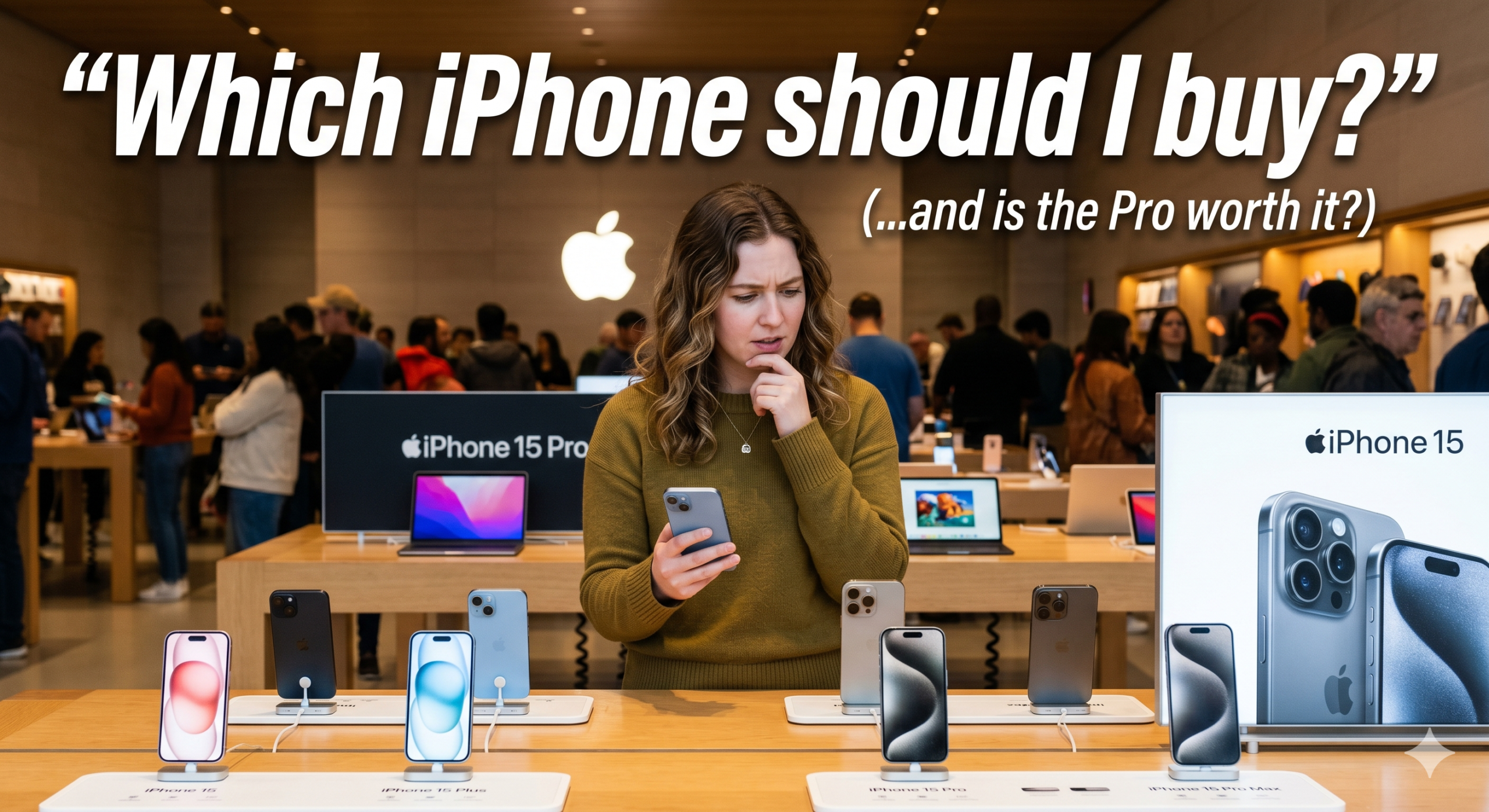
Apple did something quietly significant with the iPhone 17. They didn’t raise the price. The standard model still starts at £799, just like the iPhone 16 did. But what £799 now buys you has fundamentally changed.
For the first time, the entry-level iPhone gets the ProMotion 120Hz display that used to be a Pro-only feature. The starting storage doubled from 128GB to 256GB. The front camera jumped from 12MP to 18MP with Centre Stage. You get the same Action button and Camera Control button as the Pro models, the same Ceramic Shield 2 glass, and the same iOS 26 software experience.
The honest comparison: 90% of buyers will not notice a meaningful difference between the iPhone 17 and the iPhone 17 Pro Max in everyday use. The Pro Max has a better telephoto camera, slightly longer battery, and the cosmic orange colour everyone’s been photographing. None of those things matter if you don’t do mobile photography for a living or game heavily on a phone.
Choose the iPhone 17 if you:
- Want the best-value flagship iPhone Apple has ever sold
- Are upgrading from an iPhone 12, 13 or 14 and want a meaningful jump
- Don’t need a telephoto zoom lens (the 48MP main camera handles 2x crops well)
- Want a future-proof phone that will run iOS for 6+ years
Don’t buy the iPhone 17 if you:
- Need optical zoom beyond 2x for sports, wildlife or events photography
- Want the absolute longest battery life — the Pro Max wins by 6+ hours
- Care about premium materials — the 17 is aluminium, not titanium
iPhone 17 Pro Max — The Best Overall iPhone
If money isn’t the deciding factor, the iPhone 17 Pro Max at £1,199 is the best phone Apple has ever made. The 6.9-inch display, the 39-hour video playback battery, the new vapor chamber cooling, the 4x optical zoom telephoto with up to 8x optical-quality crops — it’s a comprehensively excellent piece of hardware.
What’s notable is the £100 price gap between the Pro and the Pro Max. With both phones starting at 256GB, the only meaningful difference is screen size and battery capacity. If you don’t want a 6.9-inch phone in your pocket, the 17 Pro at £1,099 gives you everything else.
The repair-specialist note: Pro Max models are physically harder to handle one-handed, which means they get dropped more often. The 17 Pro Max also has the most expensive screen of any current iPhone — a real-world repair cost we cover later in this guide.
iPhone Air — The Style Pick (With Trade-offs)
The iPhone Air is genuinely beautiful. At 5.6mm thick and around 165g, it’s the thinnest iPhone Apple has ever made, with a titanium frame and a 6.5-inch display. It replaces the Plus model in Apple’s lineup.
It also represents the biggest set of trade-offs in the current iPhone range. There’s a single rear camera (no ultrawide, no telephoto). The battery is smaller than every other 17-series model. And the ultra-thin frame, while engineering-impressive, is genuinely more vulnerable to bending damage than thicker designs.
The repair-specialist note: Thin phones bend. We’ve already started seeing iPhone Air models come in with frame damage from being kept in back pockets and sat on. The single rear camera also means that camera repairs are simpler in theory but more expensive in practice because the camera assembly is integrated more tightly into the frame.
Buy the iPhone Air if you specifically want a design statement and you’re disciplined about how you carry your phone. Don’t buy it as a “do everything” phone — the standard iPhone 17 is more capable for the same money, and the iPhone 17 Pro is genuinely better in every way except thinness for £100 more.
iPhone 16e — The Smart Budget Buy
At £599, the iPhone 16e is the cheapest new iPhone Apple sells. It’s a more focused phone than the standard models — single rear camera, 60Hz display (no ProMotion), no MagSafe, physical notch instead of Dynamic Island — but it has the same A18 chip as the iPhone 16 and full Apple Intelligence support.
That last point is the critical one. Apple Intelligence is the umbrella term for the AI features Apple is building into iOS 26 and beyond — the smarter Siri, image generation, writing tools, message summaries. Phones without Apple Intelligence support will increasingly feel left behind as iOS updates ship more AI-powered features.
Every iPhone 17 supports Apple Intelligence. Every iPhone 16 supports Apple Intelligence. The iPhone 16e supports Apple Intelligence. The iPhone 15 Pro and 15 Pro Max support it. The standard iPhone 15 and iPhone 15 Plus do NOT support Apple Intelligence. This is the single most important fact for budget buyers, and most buying guides bury it.
Should You Buy a Last-Generation iPhone Instead?
The iPhone 16, 16 Plus, 16 Pro and 16 Pro Max are still excellent phones, and now sell at meaningful discounts compared to the 17-series equivalents. If you can find an iPhone 16 for £100+ less than an iPhone 17, that’s a genuine value play. If you can find an iPhone 16 Pro Max for £200 less than the 17 Pro Max, even more so.
| Model | Apple Intelligence | Display | Approx UK Price 2026 | Verdict |
|---|---|---|---|---|
| iPhone 17 | Yes | 6.3″ ProMotion 120Hz | £799 | Best buy |
| iPhone 16 | Yes | 6.1″ 60Hz | ~£699 | Buy if £100+ cheaper |
| iPhone 16e | Yes | 6.1″ 60Hz | £599 | Best budget buy |
| iPhone 15 | No | 6.1″ 60Hz | ~£599 | Avoid — no Apple Intelligence |
| iPhone 15 Pro | Yes | 6.1″ ProMotion 120Hz | ~£799 | Good if found cheaper than 17 |
| iPhone 15 Pro Max | Yes | 6.7″ ProMotion 120Hz | ~£999 | Excellent value vs 17 Pro Max |
What the Tech Sites Don’t Tell You: The Long-Term Cost of Owning an iPhone
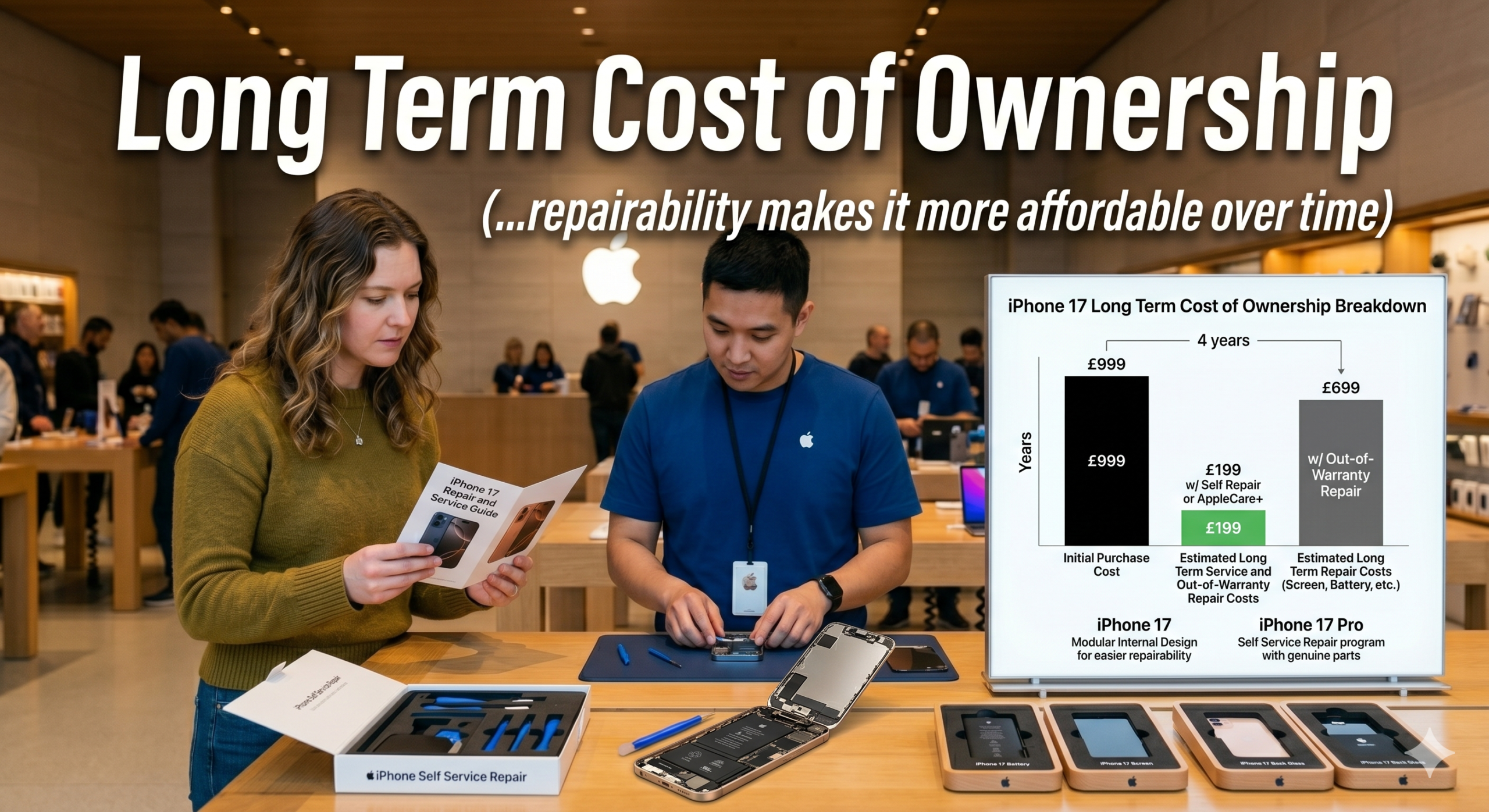
Every other iPhone buying guide focuses on the purchase price. None of them tell you what owning the phone costs you over the next four years. After 12 years repairing iPhones in East Yorkshire, here’s the part nobody else writes.
Screen Repairs: Wildly Different Costs Between Models
The screen is the most-repaired component on any iPhone. Drop your phone face-down on a paving slab and you’ll find out fast. Replacement costs vary enormously between models, and this should genuinely factor into which one you buy.
For a detailed breakdown of the difference between LCD and OLED replacement screens — and why it matters when you eventually need a repair — see our guide to choosing the right screen for your iPhone repair.
Roughly, the more recent and more premium your iPhone, the more it costs to fix when it breaks. An iPhone 17 Pro Max screen costs more than three times what an iPhone 13 screen costs. That’s worth thinking about before you commit £1,199 to a phone you’ll be carrying every day for the next four years.
Battery Life: Every iPhone Will Need a Battery Eventually
Apple rates iPhone batteries to retain 80% of their original capacity after 1,000 charge cycles, which is roughly 2.5 to 3 years of typical use. After that, you’ll notice your phone dying earlier in the day, struggling in cold weather, or shutting down unexpectedly.
A battery replacement is the single highest-impact repair you can do on an older iPhone. A three-year-old iPhone 14 with a fresh battery feels like a different phone — and at typical replacement prices, it’s a fraction of the cost of upgrading to a new model. Don’t write off your current phone just because the battery’s tired.
Repair Lifespan vs Software Lifespan
This is the part the tech sites really miss. Apple supports iPhones with iOS updates for around 6 to 7 years. After that, your phone keeps working but stops getting new features and security patches. That’s the “software lifespan.”
The “repair lifespan” is much longer. Independent repair specialists can keep iPhones running for 8 to 10+ years as long as parts are still available — and parts for popular models stay available for a very long time. We still routinely repair iPhone 7 and iPhone 8 models from 2016 and 2017, mostly screens and batteries.
What this means for your buying decision: an iPhone purchased in 2026 should last you until at least 2032 if you’re prepared to do one battery replacement and possibly one screen repair along the way. The total cost of ownership — purchase price plus realistic repair costs over the lifetime — is much lower than people assume.
Repair Considerations by Model
| iPhone Model | Repair Difficulty | Notes |
|---|---|---|
| iPhone 17 / 17 Pro | Standard | Standard repair complexity, parts widely available |
| iPhone 17 Pro Max | Standard | Same complexity as 17 Pro, but parts cost more due to larger screen |
| iPhone Air | Difficult | Ultra-thin design more prone to damage; tighter internal layout |
| iPhone 16e | Easy | Simpler internal layout; lower parts cost; great long-term value |
| iPhone 16 / 16 Pro | Standard | Mature repair process; parts well-stocked across the industry |
| iPhone 15 series | Standard | Established repair process; the 15 Pro Max battery is excellent |
How to Choose: A Simple Decision Framework
Forget the spec sheets for a moment. Answer these four questions and the right iPhone usually picks itself.
1. What’s your budget? Under £700 — iPhone 16e. £700 to £900 — iPhone 17. £900 to £1,200 — iPhone 17 Pro. £1,200+ — iPhone 17 Pro Max.
2. Are you a heavy camera user? If you take a lot of zoomed-in photos, you need a Pro model with the telephoto lens. If you mostly take regular and group shots, the iPhone 17’s main camera is more than enough.
3. How long will you keep it? Two years or less — anything works, prioritise resale value. Three to five years — make sure it has Apple Intelligence (so 16e or newer, or 15 Pro/Pro Max). Five years or more — buy current-generation, factor in one battery replacement.
4. How careful are you with phones? Honest with yourself? If you’ve broken every phone you’ve ever owned, the iPhone Air is not for you. The standard iPhone 17 with a decent case is the practical choice.
Where to Buy in East Yorkshire (and What to Do When It Breaks)
You can buy a new iPhone directly from Apple, from a UK retailer like Currys or Argos, or on contract through your network. The price is broadly the same — Apple sets it. The decision is really about whether you want trade-in credit (best at Apple), monthly contract finance (best with networks) or buy-now-pay-later options (best at retailers like Argos).
For UK buyers in Market Weighton, Pocklington, Beverley, South Cave, Brough, Driffield and the surrounding area, the more important question is what happens when something goes wrong with your iPhone after the warranty runs out. The nearest Apple Store is in Leeds, an hour each way. Most independent repair specialists in East Yorkshire either don’t carry parts for the latest models or charge prices that make replacement seem cheaper.
Mend My iPhone in Market Weighton has been repairing iPhones for 12 years, with a 4.9-star Google rating. We carry parts for every iPhone model from the iPhone 6 through to the iPhone 17 Pro Max. Most screen repairs are completed in around an hour. We also offer a callout service across East Yorkshire — meaning we’ll come to you, repair your phone in front of you, and you never have to drop it off and wait. Visit our iPhone repairs page for current pricing and to book a slot.
The Final Recommendation
The standard iPhone 17 at £799 is the best iPhone for the vast majority of UK buyers in 2026. It’s the best-value flagship Apple has ever released, it has the features that genuinely matter, and the long-term repair economics are sensible.
If you have the budget and you’ll genuinely use the camera and the bigger screen, the iPhone 17 Pro Max is the best phone money can buy — accept that you’re paying a 50% premium over the 17 for a 10% improvement in real-world experience.
If you’re on a budget, the iPhone 16e at £599 is a smarter buy than a discounted iPhone 15 because it supports Apple Intelligence and the iPhone 15 doesn’t. Don’t be tempted by the older model just to save £50.
And whatever you buy — get a case, get screen protection, and remember that a £40 case is the cheapest insurance policy you’ll ever buy against a £200+ screen repair.
Frequently Asked Questions
Which iPhone should I buy in 2026?
For most people, the standard iPhone 17 is the best buy in 2026. It has a 6.3-inch ProMotion display, an A19 chip, 256GB starting storage and the same selfie camera as the Pro models, all at £799. Power users should choose the iPhone 17 Pro Max, and budget buyers should look at the iPhone 16e at £599.
Which iPhone has the best value for money in 2026?
The standard iPhone 17 at £799 is the best value iPhone in 2026. It includes ProMotion 120Hz display, 256GB storage, an 18MP front camera and the A19 chip — features previously reserved for Pro models — without the £300 Pro premium.
Is the iPhone Air worth buying?
The iPhone Air is worth buying if you specifically want the thinnest iPhone ever made (5.6mm) and prefer style over substance. However, it has only one rear camera and shorter battery life than other iPhone 17 models. From a repair perspective, the Air’s ultra-thin titanium frame is more vulnerable to bending damage and harder to repair than thicker models.
Is the iPhone 15 still worth buying in 2026?
Yes, the iPhone 15 is still worth buying in 2026, especially at its reduced price of around £599. It has USB-C, the Dynamic Island, a 48MP camera and supports current iOS versions. However, it lacks Apple Intelligence support, which means it will miss out on the AI features Apple is building into future iOS versions.
Which iPhone has the longest battery life?
The iPhone 17 Pro Max has the longest battery life of any iPhone, rated at up to 39 hours of video playback. The iPhone 17 Pro is second, followed by the iPhone 16 Pro Max. The iPhone Air has the shortest battery life of the current line-up due to its ultra-thin design.
How long will my new iPhone be repairable?
Apple typically supports iPhones with software updates for 6 to 7 years after launch. Independent repair specialists like Mend My iPhone in Market Weighton can repair iPhones for far longer than that — we still routinely repair iPhone 7 and 8 models from 2016 and 2017. Screens, batteries and charge ports remain repairable for as long as parts are available, which is usually 8+ years.
Do all current iPhones support Apple Intelligence?
All iPhones in the iPhone 17 series, the iPhone 16 series and the iPhone 16e support Apple Intelligence. The iPhone 15 Pro and 15 Pro Max also support it. The standard iPhone 15 and iPhone 15 Plus do NOT support Apple Intelligence — this is the single biggest reason to consider an iPhone 16 or newer over a 15.
Which iPhone is most repairable?
The iPhone 17 standard model and iPhone 16e are the most cost-effective to repair due to lower parts costs and standard non-titanium construction. The iPhone Air is the hardest to repair due to its ultra-thin design. The Pro Max models are repairable but parts cost significantly more. From a long-term cost-of-ownership view, the standard iPhone 17 is the best balance of capability and repair affordability.
- Your iPad Just Got Cut Off From iPadOS 27 — Here’s What That Actually Costs You
- Water Damaged Amazon Fire Tablet: A Board-Level Repair Walkthrough
- Best Rugged Phones for Tradespeople and Farmers in 2026 — and Where to Actually Buy Them
- Call out iPhone repair to Haxby Bakehouse, York
- Don’t Throw Away Your “Incompatible” Windows 10 PC Just Yet
Leave a Reply