
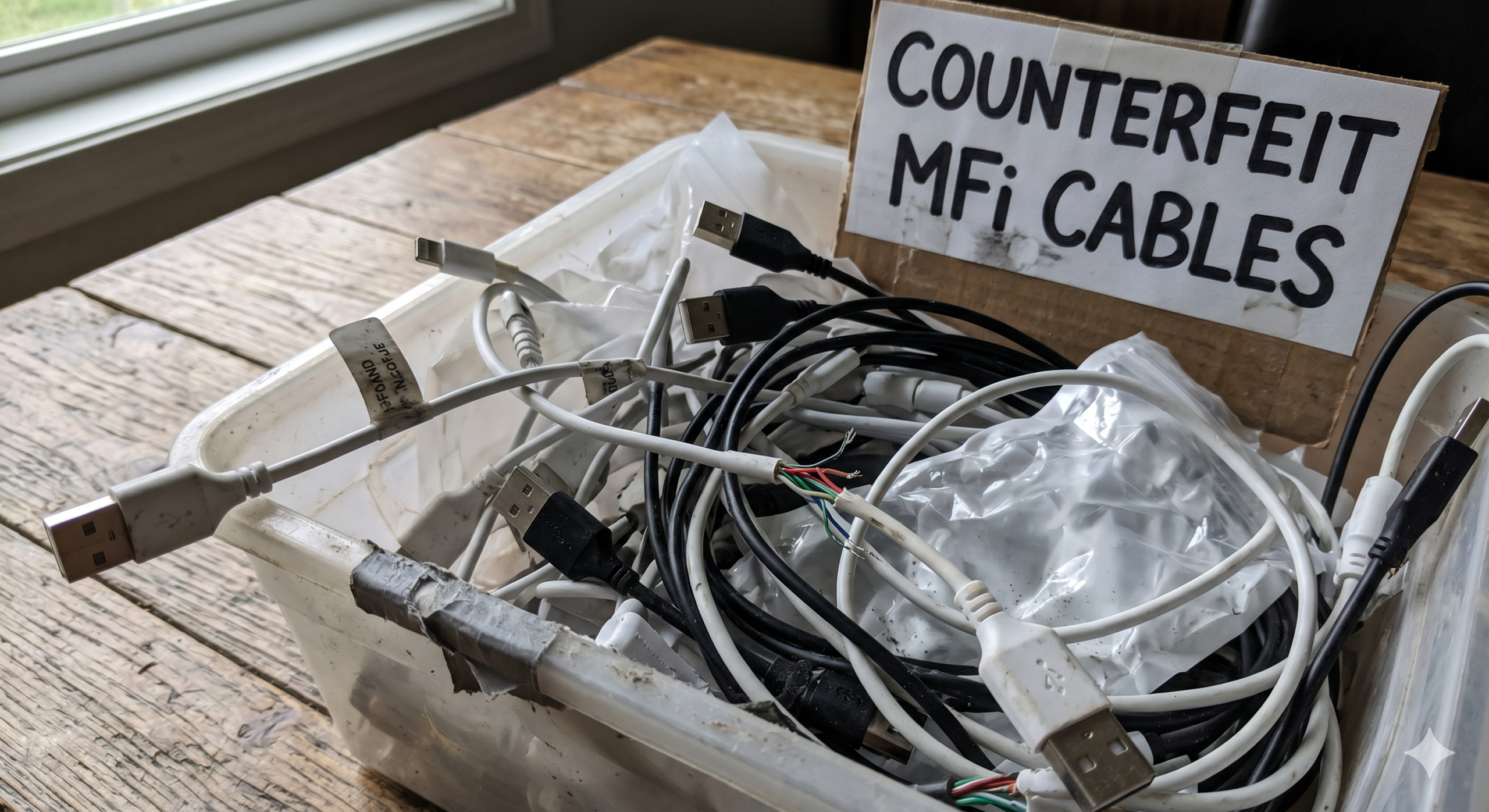
Direct Answer: Counterfeit MFi cables are widespread — Apple’s own investigation of Amazon found roughly 90% of supposedly Apple-branded Lightning cables were counterfeit. Fakes use printed-on MFi stickers and cloned authentication chips to fool consumers and (sometimes) iOS itself. The risks are real: voltage damage to your battery, port damage from poorly-fitted connectors, slow or unstable charging, and in rare cases overheating fires. Spot them by checking the brand, the packaging, the price (£15-25 is the genuine zone, anything under £8 is suspicious), and the seller. Buy from Apple, Anker, Belkin, Nomad, Native Union, or reputable retailers.
Key Takeaways
- Counterfeit MFi cables are far more common than most people think — Apple’s own data suggests up to 90% of marketplace “Apple” cables are fake.
- The fakes use cloned authentication chips that sometimes fool iOS, so charging without an error message doesn’t prove a cable is genuine.
- Best defence: buy from named brands (Apple, Anker, Belkin, Nomad, Native Union, Mophie) at reputable retailers. Avoid marketplace listings under £8 entirely.
Counterfeit MFi Cables — How to Spot the Fakes Before They Damage Your iPhone
The cable counterfeit problem is bigger than most consumers realise. When Apple investigated the cables being sold on Amazon as “Apple Lightning cables” in 2016, they found around 90% were counterfeit. That figure has come down somewhat since Amazon tightened its policies, but the problem hasn’t gone away — it’s just moved to other marketplaces and physical shops. The economics are simple: a genuine MFi cable costs the manufacturer around £4-6 to produce. A counterfeit costs less than £1. The margin on selling fakes as the real thing is enormous, and the legal risk is small for sellers operating internationally.
This post is about how to spot them, what they actually do to your phone, and what to buy instead.
What “MFi” actually means and why fakes exist
MFi stands for “Made For iPhone / iPad / iPod.” It’s Apple’s licensing programme for Lightning accessories. Manufacturers pay Apple a fee, the cable is tested for safety and performance, and a small authentication chip is included that handshakes with iOS. The genuine MFi badge means:
- The cable has been tested to Apple’s specifications
- Voltage regulation has been verified
- The authentication chip is genuine
- The manufacturer is on Apple’s approved list
Counterfeiters fake all of this. They print the MFi logo on packaging without authorisation. They produce cables without the proper internal regulation components. They use cloned authentication chips bought on the grey market — chips that often work just well enough to pass iOS’s basic checks. And they sell the result for less than the licensing fee a legitimate manufacturer would pay Apple.
The result: a cable that looks genuine, sometimes charges your iPhone without complaint, and silently damages it over time.
The seven signs of a counterfeit cable
| Sign | What to look for | What it means |
|---|---|---|
| 1. Suspiciously low price | Cable under £8 sold as “MFi certified” | Genuine MFi cables cost manufacturers £4-6 to produce. £8 retail leaves no profit. £3 retail is impossible without counterfeit. |
| 2. Generic packaging | Plain box, no branding, just “Charging Cable for iPhone” | Genuine brands invest in branded packaging. Generic packaging suggests the seller has no brand to protect. |
| 3. No manufacturer details | No company name, address, or website on the packaging | Real brands legally must include this. Counterfeiters frequently omit it. |
| 4. MFi logo too perfect or too off | Compare against Apple’s MFi logo guidelines online | Counterfeits sometimes use slightly wrong colours, fonts, or logo proportions. Sometimes the logo looks suspiciously crisp on cheap-feeling packaging. |
| 5. Bulk multipacks | “3-pack of MFi cables for £15” | Genuine MFi cables are rarely sold in bulk packs of 3+ at low prices. The economics don’t work. |
| 6. Build quality clues | Loose-feeling connectors, uneven seams, cheap plastic strain relief | Genuine cables have tight tolerances and reinforced strain relief at the connector. Counterfeits cut corners on the bits you can feel. |
| 7. Sold by unknown third-party seller on a marketplace | Amazon listings from unfamiliar names with stock photos | The most common channel for counterfeits. Check the seller’s name, reviews, and how long they’ve been on the platform. |
The risks — what counterfeit cables actually do to your phone
The risks aren’t theoretical. Here’s what we see at the repair bench when customers bring in iPhones that have been on counterfeit cables for months:
- Battery degradation. Counterfeit cables often deliver inconsistent voltage. The iPhone’s battery management chip handles small fluctuations, but sustained borderline-spec voltage over months accelerates battery wear. Affected iPhones often show 90%+ battery health drop to 80% in 12-18 months instead of the typical 24-30 months.
- Charging port damage. Counterfeit cables have lower manufacturing tolerances on connector pins. They fit slightly loose, and that looseness wears the port from the inside. After hundreds of insertions, the port wobbles. £45 to repair what could have been avoided.
- “This accessory may not be supported” warnings. Cloned chips occasionally fail iOS authentication randomly. The warning appears, charging slows or stops, the customer assumes the phone is faulty.
- Slow charging. Counterfeit cables often skip the components needed for fast charging. The phone charges at 5W instead of 20W, and the customer wonders why their phone is so slow to charge.
- Overheating. Lower-quality conductors generate more heat under load. Most counterfeit cables stay within survivable limits, but a small fraction get dangerously hot. Apple’s own incident reports mention counterfeits causing fires.
- Data corruption. Fewer counterfeit cables include proper data lines. If you try to sync or back up, the connection drops. Your iTunes / Finder backup gets corrupted partway through.
Where counterfeits are sold
The risk varies dramatically by channel:
| Where you buy | Counterfeit risk |
|---|---|
| Apple Store / apple.com | None |
| John Lewis, Currys, Argos, Tesco | Very low |
| Manufacturer’s own website (Anker, Belkin etc.) | None |
| Amazon “Sold by Amazon” listings | Low |
| Amazon third-party sellers | Moderate to high |
| eBay | High |
| Service stations and motorway shops | High |
| Pound shops and discount shops | Very high |
| Market stalls | Very high |
| “Apple-style” kiosks in shopping centres | Very high |
The pattern: the further from official supply chains, the higher the risk. If a deal feels too good to be true, it’s probably a counterfeit.
What to buy instead — verified safe brands
- Apple’s own Lightning and USB-C cables — £19-29. Most reliable but most expensive.
- Anker PowerLine III — £15-22. Excellent value, MFi certified, 18-month warranty. The best budget pick.
- Belkin Boost Charge — £15-20. Reliable mid-range option, MFi certified.
- Nomad braided cables — £25-35. Premium build quality, designed to last 4-5 years.
- Native Union — £25-35. Premium with style, MFi certified.
- Mophie — £15-25. Reliable, widely available in Currys and John Lewis.
For USB-C cables (iPhone 15 onwards), the same brands all make USB-IF certified USB-C cables. The principle is the same: known brand, reputable retailer, sensible price.
What to do if you’ve already bought a counterfeit
- Stop using it immediately if it’s been showing any signs of malfunction (intermittent charging, accessory warnings, getting hot to touch).
- Check your charging port for visible damage — corrosion, bent pins, wobbly connector fit.
- Check your battery health at Settings → Battery → Battery Health & Charging. If it’s dropped faster than the typical 5-10% per year, the cable may have contributed.
- Replace the cable with a verified safe brand from the list above.
- Bring the phone in for a free diagnostic if you suspect damage. We can check the port and battery condition, identify any actual harm, and quote any necessary repairs.
- If you bought from a marketplace and want to claim a refund, take photos of the cable and packaging, then contact the seller and the platform’s customer service. Marketplaces will sometimes refund counterfeits even outside their normal returns window.
The bigger picture
The counterfeit cable problem is a quiet tax on iPhone owners. Most people will buy at least one counterfeit cable in the lifetime of their phone, often without realising. The damage is usually small and gradual — a few percent of battery health, a slightly worn port, a few months less life out of the phone. But across millions of iPhones, the cumulative cost is enormous, and the people paying it are the consumers who thought they were getting a deal.
The defence is straightforward and not expensive. Buy named-brand cables. Buy from reputable retailers. Spend £15-25 on a cable and replace it every 2-3 years. Treat the counterfeit listings on marketplace sites the same way you’d treat any obviously-fake luxury good: ignore them entirely.
Related reading on cable choices and charging issues
- The true cost of a cheap iPhone cable — full breakdown of MFi vs USB-IF, when to bin a cable, what to buy
- “This accessory may not be supported” — what it means and how to fix it — the warning that often signals a counterfeit
- Wired vs wireless vs MagSafe — which is best for your battery long-term — the bigger picture of charging and battery health
Frequently Asked Questions
How common are counterfeit iPhone cables?
More common than most consumers realise. Apple’s own investigations of cables sold on Amazon found that approximately 90% of supposedly Apple-branded Lightning cables and chargers were counterfeit. Marketplace sites, service stations, discount shops, and pound shops are the highest-risk sources. Even some legitimate retailers have unknowingly sold counterfeits supplied through unofficial channels.
How can I tell if my iPhone cable is a genuine MFi cable?
Look for: branded packaging from a recognised manufacturer (Apple, Anker, Belkin, Nomad, Native Union, Mophie); a clear MFi logo on the packaging; manufacturer details and a contact address; a price in the £15-30 range (cables under £8 from unknown brands are almost always fake); reasonable build quality with even seams and proper strain relief at the connectors.
What are the risks of using a counterfeit Lightning cable?
Counterfeit cables typically lack proper voltage regulation, use cloned authentication chips that iOS may reject, and are built from lower-grade materials. Risks include: gradual battery degradation from voltage fluctuations, charging port damage from poorly-fitted connectors, intermittent charging, the ‘this accessory may not be supported’ warning, slow charging speeds, and in rare cases overheating that can cause fires.
Where are counterfeit iPhone cables most often sold?
The highest-risk channels are: third-party marketplace sellers on Amazon and eBay (especially listings priced significantly below average), service station accessory aisles, pound shops and discount stores, mobile phone market stalls, and unofficial ‘Apple-style’ shops in shopping centres. Buying directly from Apple, John Lewis, Currys, Argos, or the manufacturer’s own website is significantly safer.
Will iOS detect a counterfeit Lightning cable?
Sometimes, but not always. The ‘this accessory may not be supported’ warning is iOS’s way of flagging cables it can’t authenticate, and counterfeit cables with poorly-cloned chips trigger this regularly. However, many counterfeit cables now use closely-cloned chip IDs that pass iOS authentication. The fact that your iPhone charges without complaint doesn’t prove the cable is genuine.
What should I do if I bought a counterfeit iPhone cable?
Stop using it immediately, especially if you’ve noticed any signs of overheating, intermittent charging, or the ‘accessory may not be supported’ warning. Inspect your charging port for damage. If the iPhone has been showing slow charging or battery degradation since you started using the cable, bring it in for a free diagnostic. Most damage from counterfeit cables is gradual and reversible if caught early.
Is there any safe way to buy a cheap iPhone cable?
Yes — buy from reputable budget brands rather than no-name sellers. Anker is the standout value brand: their PowerLine series is MFi certified, costs around £12-18, and offers genuine quality at lower prices than Apple’s own cables. Belkin is another reliable budget option. The point isn’t that you must spend £25+; it’s that you must avoid the counterfeit category entirely.
Need help checking your cable or phone?
If you’re unsure whether the cable you’ve been using is genuine, or you’re worried it’s already damaged your iPhone, drop into Mend My iPhone in Market Weighton or book a callout to your home or workplace across East Yorkshire. Free diagnostic, honest advice, no pressure to repair anything that doesn’t need it.
Leave a Reply