
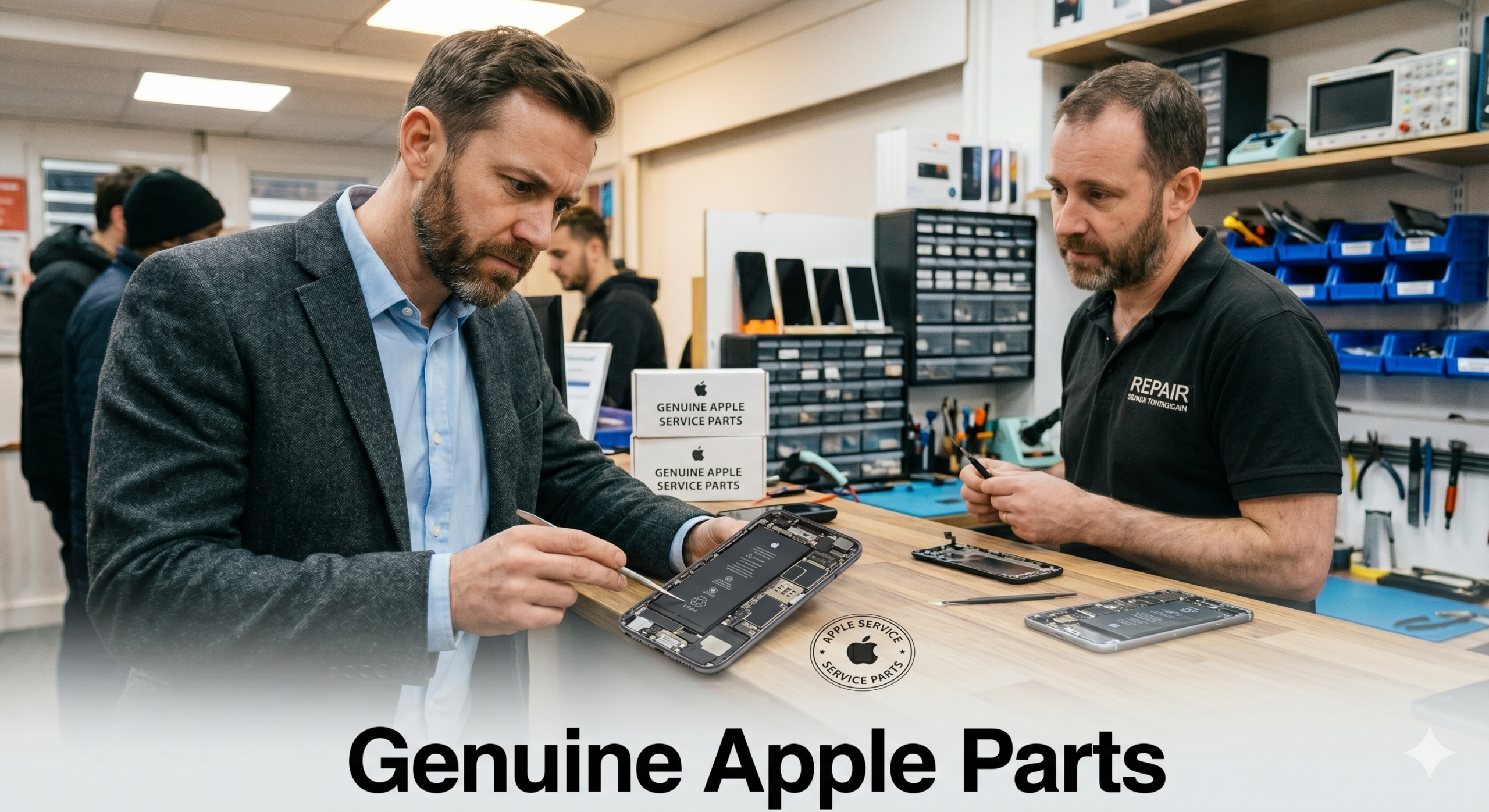
Something has shifted in the last 12 months. Here’s what’s behind it, what it means for you as a customer, and where the repair industry goes from here.
If you’d asked me two years ago whether customers regularly enquired about parts provenance before a repair, the honest answer would have been rarely. Most people wanted to know two things — how much and how long. That was the conversation.
That conversation has changed. Increasingly, customers are walking in — or calling — and asking specifically whether we use genuine Apple parts. It’s happening more often, more consistently, and from customers who wouldn’t previously have known what an OEM part was.
Something has clearly shifted. And I think I know exactly what it is.
Apple’s Warning System — What It Actually Is
With iOS 15.2 and later, iPhone users can go to Settings → General → About to check the parts and service history of their device. If a repair was carried out using genuine Apple parts and processes, the entry shows as Genuine. In some situations — such as if the part was replaced with a non-genuine part — the device shows an Unknown message instead. Wikipedia
On newer devices it goes further. If you’re using an iPhone 15 or later with iOS 18, it will display a Used message if the screen or battery was previously installed in another iPhone, or an Unknown message if the part is non-genuine. 9meters
These aren’t subtle notifications buried in a menu most people never open. Apple has made them increasingly visible, increasingly prominent, and increasingly anxiety-inducing for anyone who sees one after a repair. iFixit described Apple’s approach as another way to make third-party repair seem annoying and uncertain. Fandom
And it’s working. Not because the parts are necessarily inferior — but because the warning exists at all.
The Psychology Behind the Question
Here’s what I think is actually happening when a customer asks if I use genuine parts. They’re not asking because they’ve researched component specifications. They’re asking because they’ve either seen one of these warning messages on their own phone or a friend’s phone after a previous repair, or they’ve heard about it happening and it’s lodged somewhere in the back of their mind as a concern.
Non-Apple replacements always appear as Unknown Part. However, these components are functionally equivalent to OEM counterparts and perform just as well. Samsung Galaxy The warning doesn’t mean the part is fake or faulty. It means Apple’s system doesn’t recognise it as one of its own — which is a very different thing.
But that distinction requires explanation. And most customers don’t get that explanation at the point of seeing the message. They just see a warning on their iPhone and feel unsettled.
Apple has essentially trained millions of iPhone users to be suspicious of independent repair — not through product quality, but through notifications. It’s a masterclass in leveraging the operating system to influence consumer behaviour at scale. Whether you find that admirable or cynical depends on your perspective. Probably both.
What Genuine Apple Parts Actually Means in Practice
Genuine Apple parts are individually calibrated with data uploaded to Apple’s servers and stored at the time of manufacture. This calibration process ensures that parts meet performance, security, privacy, and safety expectations. Wikipedia
For screens this means full True Tone support, accurate colour calibration and proper brightness behaviour. For batteries it means accurate health reporting in Settings and proper integration with iOS power management. These are real functional differences — not marketing.
Independent Repair Providers have access to genuine Apple parts, tools, training, service guides, diagnostics and resources. Wikipedia So the option to use genuine parts through an independent repairer does exist — but it comes at a cost. Genuine Apple parts sourced through official channels are significantly more expensive than aftermarket alternatives, and that cost flows through to the customer.
The High Street Repair Market — Where This Goes
This is the interesting question. And it’s one the industry hasn’t fully reckoned with yet.
For years, independent repair shops competed primarily on price and speed. The parts market was opaque to consumers — most people didn’t know or care whether their replacement screen came from Apple’s supply chain or a third-party manufacturer. The repair worked, the phone worked, job done.
Apple’s warning system has introduced transparency where there wasn’t any before — but transparency framed entirely on Apple’s terms. The message doesn’t say “this part is lower quality.” It says “we can’t verify this.” Those are very different statements dressed up to feel the same.
What this creates for independent repairers is a fork in the road. You either:
Compete on price with non-genuine parts and accept that some customers will be bothered by the Unknown message, requiring you to explain it every time — which takes time, creates friction and occasionally loses the job anyway.
Or you offer genuine parts as a premium option — more expensive than Apple’s own repair service in some cases, but faster, more convenient, and with the personal service that no Apple Store Genius Bar visit replicates.
I’ve decided to go the second route — offering genuine Apple screens and batteries as an option alongside quality aftermarket parts. Yes, it’s more expensive. In some cases it’ll be more expensive than Apple’s own out-of-warranty repair pricing. But I’ll be faster. I won’t need an appointment three days from now. I won’t ask you to post your phone away. And you’ll leave with a phone that shows Genuine in Settings.
For some customers that matters enormously. For others the price difference makes the aftermarket option perfectly sensible. Having the choice available is what matters.
What This Means If You’re a Customer Right Now
If you’re getting a repair and you care about the Genuine status showing in your Settings — ask for it. Any repairer worth their salt should be able to offer it, should be transparent about the price difference, and should be honest about what the Unknown message actually means if you opt for a quality aftermarket part.
If you’re getting a repair and the price is the priority — a quality aftermarket screen from a reputable repairer will function perfectly well. The warning message is a notification, not a verdict.
The most important question to ask isn’t “is it genuine?” It’s “do you stand behind the part you’re fitting?” A warranty on the repair matters more than a label in Settings.
The Bigger Picture
Apple’s right to repair journey has been complex and at times contradictory. 2024 saw Apple loosening some prior restrictions, announcing support for used genuine parts for repairs on its newest iPhones — strengthening the ever-growing Right to Repair movement. 9meters So on one hand, Apple is opening up. On the other, it’s simultaneously making non-genuine parts more visible and more anxiety-inducing for consumers.
The net effect on the high street repair market will be a gradual stratification. Budget repairs with aftermarket parts at one end. Genuine part repairs — faster than Apple but priced accordingly — at the other. The middle ground gets squeezed.
For independent repairers who are transparent, skilled and willing to invest in genuine part access, this is actually an opportunity. The warning message that Apple created to protect its ecosystem may inadvertently reward the repairers professional enough to offer a genuine alternative.
We just have to be fast enough, honest enough, and good enough to justify the choice.
These are our current prices v Apple 21/3/2026
| iPhone Model | Aftermarket Oled Screen | Genuine Apple Screen | If you use Apple Directly |
| iPhone 12 | 85.00 | 370.00 | 289.00 |
| iPhone 15 | 140.00 | 370.00 | 289.00 |
| iPhone 16 Pro Max | 155.00 | 445.00 | 389.00 |
We now offer genuine Apple screens and batteries as a repair option alongside quality aftermarket parts. Both come with our repair warranty. Ask us which is right for your situation when you get in touch
Leave a Reply